


— This essay was originally published in our Winter 2025/26 issue, “Salad Days” —
The other day in lower Manhattan, I overheard a gaggle of teenagers riffing as they ate an afterschool snack. “Bro, I’m fucking gooning on these dumplings,” one kid cried in between forkfuls, clearly famished in his anime tee and Jansport backpack. At another point, they started arguing about whether streamer Hasan Piker had zapped his dog, and then if mayor-elect Zohran Mamdani was still able to “mog the libs” despite letting himself be “edged and cucked” in a White House meeting with Trump. Later that evening, I passed by Sour Mouse, a repellent bar and game hall the color of neon vomit, as it was hosting a “rave” themed after Five Nights at Freddy’s (2014–), a massively popular video game about a nighttime security guard watching a pizzeria chain with creepy animatronics that try to murder you. I walked past four West Village girls loudly complaining that the longtime kosher-style staple Katz’ Delicatessen had been “TikTokified,” which was okay because they were trying to slim down to look more coquette.
It’s very weird to be a young person right now. It’s always been weird being a young person, but these post-Covid, early artificial intelligence, slopocalypse times are especially bamboozling. A feeling of unreality courses through everything, our economy polluted by get-rich-quick ploys: shitcoin rug-pulls, mercurial speculation markets, TikTok Shop ashwagandha pyramid schemes. Tasked with periodizing the moment, I find myself lost in a vortex of half-ideas that mirror culture’s wider fragmentation. We are not in an era of utopian optimism, nor punk rage, nor detached irony, nor brand-building aspiration. We’re in all of these moments and a thousand more all at once. But instead of throwing my hands up before I’ve even started, I’m going to do my best to snatch sense and structure out of the chaos fogging all our brains – to reveal the forest AND the trees.
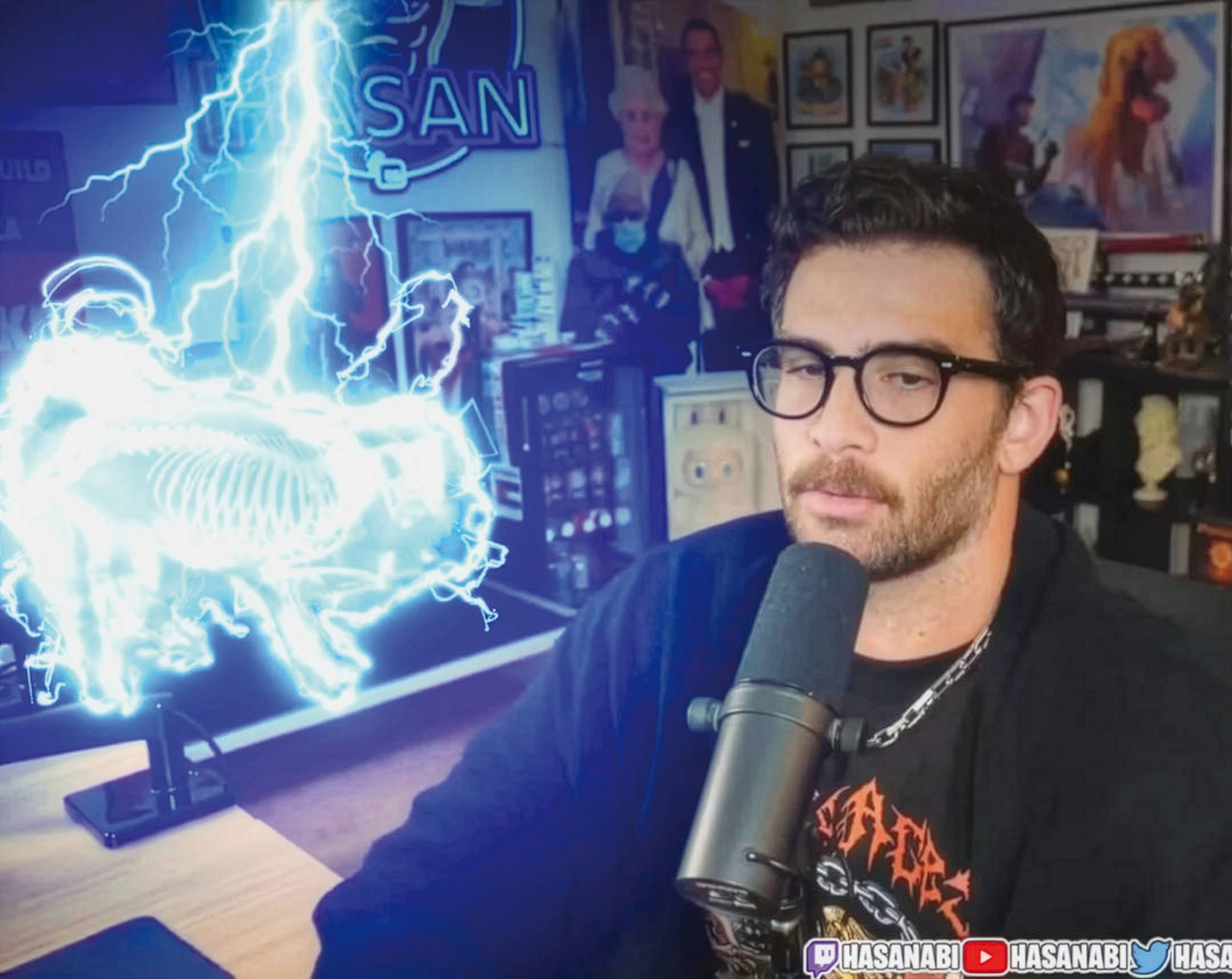
Streamer, influencer, and political commentator Hasan Piker, who may or may not have collar-shocked his dog on camera
Cognitive Offloading
Supercharging the 2020s, or rather actually draining our era’s life force, is a widespread tendency to cognitively offload, or to in some way outsource or diminish one’s capacity to pay thoughtful attention. Cognitive offloading feels like low-wattage engagement with reality, or like your body is operating on a “low-battery” laptop setting sans CPU strain. At the root of all this are algorithms, and the way tech companies have found the canniest possible methods of short-circuiting your pleasure centers and delivering you personalized stimuli. The machine has turned people into dolls; the doomscrolling flick of the wrist has become natural, unconscious, the slopgen subject’s invisible ummmmbilical cord. We descend a short-form skyscraper that never ends, a vertical ouroboros of addictive content. This is a condition that afflicts all generations – my own grandparents watch Instagram Reels – but most of Gen Z’s new media forms feel actively designed to induce such inertia.
Take the YouTube vlogs “retention-edited” with a constant flurry of effects and transitions to entrance you, or “second-screen” TV shows like Emily In Paris (2020–) that are built to be watched ambiently so you can also soak in the phone pixels. In China, a whole industry of internet fiction has thrived by emptying itself out (in favor of formulaic plots, clichés, and simplified narratives) to please demandingly dumb audiences. It’s even taken over some of the most avant-garde strains of underground music. Rage rap has lost some of its subversive edge and careened into a kind of Catharsis Industrial Complex, with artists born this millennium like OsamaSon, Ken Carson, and che competing to sell mosh-pits with the most destructive beats – paradoxically a kind of hyper-agitated stasis – to the young masses.
This music is joyously and chillingly devoid of thought. Mosh-pit maestro 2hollis has spoken about wanting to morph himself into “a feminine, androgynous character that’s almost unreal… somewhat angelic,” an idol in the K-pop vein that’s beyond perfect – a vessel of deliquescent capital that can be objectified and consumed, injected directly into the nerves. There’s a new microgenre (by artists like ocelot and 3c876) that pushes this to the brain-obliterating brink. Tracks seem custom-designed to suit “jugg edits,” a type of hype montage that’s like short-form stochastic terrorism, or the algorithm seizing up in a bout of ecstatic epileptic fever.
For normal teenagers and twentysomethings, AI has cranked up the cognitive destruction to a different level of scary, both in the entertainment it has spawned (the uber-satisfying slop, the Giantess Mommy Milker porn, the Italian brainrot gibberish) and the way people use it. ChatGPT helps write flirtatious texts, professional emails; users ask it for recipes, restaurants, movies; they treat it like a therapist, a parent, a lover. Many people already don’t think very hard in the first place, and this basically atrophies the willpower to do any of the mental work that comes with decision-making, problem-solving, or even creative thinking.
When every sliver of history is available online, what matters to the cognitively offloaded slopgen child is an influencer who can tell them exactly which Rick Owens boot is the coolest.
Maybe the fittingest avatar of the 2020s slopgeneration is the YouTuber Fulcrum (birth name Damian Luck). He is the human incarnation of cognitive offload, and the purveyor of a kind of content realism whereby one has no conception of themselves and the world other than as content to consume. In his videos, Fulcrum would walk into chain stores and hit his dab pen until he was surpassingly baked, kindly harassing bemused strangers and rambling nonsense about how he was going to “Yodie Land” or howling “FADED THAN A HOE!” Nearly every episode is the same copy-pasted “raw thoughts.” After every watch, it felt like you’d just wasted your time, which was kind of beautiful when set against a contentscape that’s always trying to teach you how to be more optimized or sell you something. But like the internet’s own trajectory, Fulcrum’s sunniness curdled into dread, and he spiraled down conspiratorial rabbit holes about the Covid vaccine and trans people. Last I checked, he’s just a hollow caricature of himself, a husk drifting through the digital strip mall and begging people to pay attention.
Sense-Inundation Chamber
The flipside of manic moshing and abrasive influencers trolling in public is an extreme sense of dislocation and social anomie. Pundits and young people are panicking about the “loneliness epidemic” and Gen Z’s declining sex activity. The internet has turned the weak-willed into anxious bedrotters whose only form of community is running a stan account or becoming a power user in the Twitch chat of a streamer they’re parasocially obsessed with. It’s part of the reason why ASMR (a genre of whispery relaxation videos), with its creepily simulated intimacy, is so popular – a content genre built for hikikomoris who need it like a Vitamin C supplement of human contact. After a day working in retail or service, because there are no other jobs left, or a day where their brains haven’t been activated at all because using AI is the easiest cheat code, many young people don’t want to read or cook. ASMR unscrews the top of their head and lets all their thoughts dissolve into a puddle, turning bimbo mode via crinkling cellophane.
At the most warped end of Zoomer (and younger) antisocial behavior, people have converted into gooners who jerk off to nine screens of porn at once. They seem to be not just rabidly horny, but also hooked on the idea of being dominated by technology itself, fetishizing cognitive offload as a quasi-religious higher state of being. Hypercharged algorithms have turned Instagram and Twitter into Pornhub for some, flooding their feeds and lubricating their id with OnlyFans ads and hypnotically swinging boobs.
Paranoia about being brainwashed by the internet is partly why young people started making corecore edits: riffs on moodboard aesthetic signifiers like “cottagecore,” which was itself a semiotized wish to flee the cluttered contentscape of today and become tradwives living on an idyllic farm in the countryside. Corecore is the next step up into pure meta – a parody-as-critique of the very idea of genre aesthetics and expressive of real longings to escape the technohell present. These edits inter-stitch clips of kids yearning to be influencers when they grow older; the environment being destroyed by data centers; homeless people being used as props in TikTok interviews. They are also full of people talking about how inexplicably depressed they are, the comments a mirror to the content, with thousands of anonymous users opening up about their life struggles. Fittingly, the trend became the exact thing it was critiquing – it was formularized into viral videos where men would idolize Patrick Bateman from American Psycho (2000) and complain about how women treated them badly. These boys are agonized for a reason, but their furor is directed at the wrong target.
Micro/Mammoth
At the same time that our attention spans and senses of selves have dissolved into the blue light, the internet and its algorithms have shredded culture into countless micro-movements. The mainstream still exists – see Barbie, Brat, the everlasting dominance of Drake, Kendrick, and Swift – but as Liz Franczak, co-host of the leftist podcast TrueAnon, told me, the feed is monoculture now. The churn is ephemeral; what endures are the macro-structure, the engagement mechanisms, and the unique-to-our-time affects and habits they implant in us helplessly addicted users.
Slang emerges and fades so swiftly that teachers are begging Redditors for guides on the latest lingo, and there are influencers (millennial) whose entire M.O. is informing you of the most popular brainrot their middle-schoolers vomit up weekly.
These new forms of culture tend to have an algorithmically driven invisible massiveness. Things hit critical virality to a subset of users while being gate-kept from the wider populace. One nineteen-year-old might spend hours daily downing clips from the new frontier of awkward ironists like TikToker Dax Flame and Instagram Reels method actor wasipthawerld, while a friend of the same demographic has never heard of them, but knows every fragment of lore about the OnlyFans content collective Bop House and influencer Emily Mariko’s recipes. For some kids, traditional TV shows have been completely eclipsed by episodic soap operas staged by players in the sandbox game Roblox, while others still watch Peppa Pig (2009–), Daniel Tiger’s Neighbourhood (2012–), and Bluey (2018–). Maybe the biggest new music genre of the 2020s, phonk – an electronic style that blends metallic hyperpop, bitcrushing, and bludgeoning Brazilian funk rhythms into a flamethrower of a sound – has become the national anthem of Gen Alpha, dominating Spotify’s Viral Chart despite being entirely impenetrable to anyone over the age of twenty-five. Even many of the people who listen to it probably don’t know its name. That’s because the cybernetic rage by rote beats have no actual scene but are puked out as playlist fodder and soundtracks for Fortnite clips, fifteen-year-old troll-face shitposts, and hype edits of celebrities with razor-sharp jawlines dunking on the less attractive – that is, for MOGGING compilations.
The terms of our URL-IRL hybrid setup have made many of these splintered new cultural movements feel empty, lacking the depth or durability to have a lasting, profound impact. Slang emerges and fades so swiftly that teachers are begging Redditors for guides on the latest lingo, and there are influencers (millennial) whose entire M.O. is informing you of the most popular brainrot their middle-schoolers vomit up weekly.
Social media algorithms surface the most aggravating content, which is how incel and looksmaxxer terminologies have slipped from the anarchic forum 4chan into the mainstream. The structure of these sites encourages ragebaiting and “clipfarming,” meaning saying provocative things that fan-proselytizers will clip and spread across social media. This has spawned a whole video game genre built for content creators I call “fury-bait.” Titles like A Difficult Game About Climbing (which consists of making tricky jumps, and if you fall, all progress is lost) are programmed for moments of bum-clenching outrage that play well on social media. The clipfarm economy has boosted slick politicos who speak at nightcore speed, like conservative commentator Ben Shapiro and YouTube debate lord Destiny, and allowed the crack-den fanbases of figures like far-right women-hater Andrew Tate and white supremacist Nick Fuentes to spread their idols’ teachings via decentralized clip-posting while their idols’ accounts are banned. In some cases, this can be used for good – take Zohran Mamdani’s hypnotic, humane slogans and perpetually smiley, clever videos – but the dumbest ideas often win out because they’re the easiest to convey in short-form media.
Fleeing Frenzy
Aghast at current conditions, some kids are fleeing the open internet under what Yancey Strickler, the co-founder of Kickstarter, calls the “Dark Forest Theory of the Internet,” or turning to more walled-off spaces. These are tucked-away Discord channels, private group chats, beta-only forums – ready fits, it seems, for some of the younger generation’s fetish for obscurity, a sometime tendency to seek handpicked curation (the farmer’s market) over algorithmic chaos (the conveyor-belt slop bowl). The result is all the nanogenres on cataloguer hubs like Letterboxd and RateYour-Music; hipster rec platforms like Perfectly Imperfect, Nina Protocol, and Silk.Node; and services like Are.na, where users sculpt dense chains of webpages into digital filing cabinets. When every sliver of history is available online, what matters to the cognitively offloaded slopgen child is an influencer who can tell them exactly which Rick Owens boot is the coolest.
Some have gone further, buying flip phones and dumbphones that can’t download apps, or straight-up shirking all tech. Peep the one hundred people wearing conical gnome hats (because “gnomes come from the Earth,” per an organizer) and marching on the High Line as part of a neo-Luddite club at The New School. Many twentysomethings are deleting their Instagram pages and/or go on silent retreats in the hinterland for dopamine detox. One of my close friends in LA, unnerved by the difficulty of socializing post-Covid, began trawling Meetup.com for local activities: now he hangs regularly with a hiking club and a board game crew. In urban centers, there’s been a surge in running groups. In New York, nightclubs like House of Yes and Elsewhere have banned phones on the dancefloor.
While retention-editing frenziness dominates much of the internet, there’s been a parallel push toward utter slowness. On YouTube, many kids seem content to watch hours-long video podcasts with minimal editing, like Jake Shane’s “Therapuss.” In music, among a cluster of underground acts in New York and abroad, a soporific turn offers something like aural healing potions for the burnt out, with lowkey electronic producers like Purelink and rock-ish weirdos like Chanel Beads and Deer Park making ambient cool and oklou’s Choke Enough (one of the best albums of 2025) languishing in lightheaded lethargy. In fashion, absent a monoculture, one of the main Gen Z crazes has come to be the uber-simple baggy all-black – the streetwear uniform of rap crew Opium. High-quality and tastefully constructed normcore – like writer Chris Black’s new brand, Hanover – will likely become the ultimate counterweight to the frenzied scatter of fast fashion brands chasing the latest internet microtrends, for people exhausted by slop and stimuli.
Liquid Selfhood
What saves the desensitized slopgen subject is her plasticity. Young people oscillate across genders and genres, swinging between abject misery and giddy euphoria. The most innovative culture in the last few years has this same slippery, ephemeral delight, a supernova of ingenuity that burns out quickly. I’m talking about things like sigilkore, a trap micro scene of hissing and snarling, and other wildly unbelievable new ways of vocalizing, from rappers who genuinely believe they’ve made pacts with deities from the underworld; it’s so terrifying it made Christians worry they would be hellbound if they listened. Profound meaning appears in unexpected places, like YouTuber Evbo’s two-hour Minecraft machinima video called Parkour Civilization that uses a made-up video game society as an analogy for class consciousness. Streamers like iShowSpeed have mastered the art of the long take, deploying enough cameras to rival a high-security bank vault and turning their lives into an always-on mash of reality and spectacle.
This omni-posture of the younger generation has completely collapsed taste boundaries and ushered in what I call shitpostmodernism, which can take the form of gleefully defacing historical conventions and etiquette (when has a mainstream artist like Ice Spice uttered a flex like “I’m the shit, I’m that bitch, I’m Miss Poopie”?) or styles steeped in the psychic decay wrought by our networked existences. The most riveting new art is less about the futuristic technology it uses (though musicians are deploying vibrato, Auto-Tune, and sound design in never-before-heard ways) than about its sense-fucking texture. It’s Los Thuthanaka (2025), the intentionally unmastered debut studio album by the namesake Bolivian-American duo that calls back to Indigenous folk traditions and Andean dances while spamming ferocious thuds and haywire DJ effects; it’s favela-born funk carioca whose obliteration-as-aesthetic shrillness is designed to pair with lança perfume, a street drug that triggers auditory hallucinations; or a song called “Air on a G String,” a reference to Johann Sebastian Bach that trashes the elegant aura of “Orchestral Suite No. 3 in D major” (c. 1731) with a Polish woman singing about her underwear sticking out as she dances down the street.
Like it or not, the slopocalypse has unleashed some of the strangest things we’ve seen in the last couple of years: nightmare AI-gen so mangled it’s like Michelin-star creepypasta, or perplexing new character archetypes you can boggle at, with perverse satisfaction. See Gavin Weiland, who got big off Instagram Reels where he recontextualized brainrot into a kind of rhythmic, pleasurably existential form of slam poetry, before succumbing to the shite he was satirizing and starting peddling gambling ads. On the flipside, we can thank the clipfarm paradigm for propelling unknowns like the model Alex Consani, whose charmingly zoinked hi-jinks and catchphrases feel purpose-built for TikTok. Andy Warhol’s fifteen minutes of fame are squeezed to a speedy fifteen seconds.

The Offline Club, London
But to be anything other than curious about the various ways young people are fighting against or being warped by the pressures of the age is to ignore the future as it’s emerging. At best, the new spirit manifests in thoughtful young people with tweaker tendencies who work in genome labs while moonlighting as niche-obsessed DJs, spending hours theorizing about Fortnite and hate-watching Infowars. It means some people are gooning, but also some kids are slapping the word “gooning” on anything, diluting the significance of all of history’s taboos into meaningless spritzes: when a man killed himself after being filmed masturbating in public at a drive-in restaurant, internet users dubbed it the “goonicide” and held a “gooneral” for him. Kids have grown up hearing about Millennial strivers taking themselves and their “online personal brands” oh so seriously, and Zoomers being sadsack screen sickos, so the result is to not give a shit about any of it; they’re allergic to the whole meta conversation of what a generation represents; anti-thinkpiece, anti-historicization. The last thing the bulk of the youth is doing is reading pieces like this. The slopgen subject just wants to exist and fuck with the things they want to fuck with; some have very passionate anti-establishment politics while others possess incoherent ideologies. Everyone is groping for novelty in the void.
I’ve been energized by the many regional artistic communities (like the Milwaukee rap scene) resisting the uprooting effect of the internet, and the throng of new fleshspace events popping up that aren’t scammy “coffee raves.” Young people seem to be trying to nurture lowkey hubs in offline “dark forests” and, in cases like New York’s Helltekk rave crew, in actual forests. They desperately want to foster non-transactional scenes, spaces where we can add freaky new meanings to the world that don’t necessitate a Faustian pact with the algorithm. The future may be illiterate, fascist, genocidal, and completely determined by artificial general intelligence, but the slopgen subject won’t ever let their subjectivity be fully colonized. Kids are not non-playable characters, even if we often act like them nowadays. Nothing can fully close the door on becoming a real person.